LGBTQ historian, journalist and novelist, St Sukie de la Croix interviews Gregg Shapiro about his new collection of short stories, How to Whistle: Expanded Edition.
Many of your stories in How to Whistle mention music. How important is music to your fiction writing?
Music is important to every facet of my writing – fiction, poetry, journalism. I’m not musical – can’t carry a tune in a paper bag, as they say. However, I appreciate those who are. Music has been central to my life since I was a child and figured out how to operate my parents’ hi-fi. My love of music has worked its way into my creative writing since the beginning. As an entertainment journalist, I am fortunate enough to be able to write about music on a regular basis.
These stories are firmly captured in time and place. Mostly the 1980s in Chicago, Boston, and Washington DC. How important is location to you?
I’m so glad you asked that question! After humor, place might be the most important aspect of my writing for me. I’ve been fortunate enough to live in some wonderful cities – Boston, Washington DC, Chicago, and now Fort Lauderdale. They are all such varied places and I hope that I have captured the energy and spirit of each.
The 1980s are mostly remembered by gay men as a time of AIDS, which figures in some of your stories. However, love, sex and humor shine through in your writing. Was it difficult writing these stories, as it was a period that you, and many others, lived through?
Great question. I recently watched the extraordinary HBO Max mini-series It’s A Sin, created by Russell T. Davies (the man behind the original Queer As Folk). The series begins in 1981 London and follows a group of friends through the decade. It’s an extraordinary production and a must-see. AIDS also figures prominently in Rebecca Makkai’s masterpiece of a novel The Great Believers from 2018, as well as in Bryan Washington’s exceptional 2020 novel Memorial. All of this is to say that, even though we are in the midst of another health crisis that was initially badly bungled by Republicans (as the AIDS crisis was 40 years ago), we must never forget the lives lost and lives forever changed. Of course, writing about it isn’t easy, but that’s even more of a reason to do so.
Most of the characters in How to Whistle are young and finding their way in life. Older readers will undoubtedly see their young selves in this book. What do you think young readers will see?
Readers seeing themselves in my work has always been an essential element of my writing. I would be so grateful if readers of a certain age find things to which they can relate, that are familiar to them, in the stories. As for younger readers, I hope that, even if their personal experiences don’t line up exactly, that there is still something universal enough to which they can gravitate.
Can you whistle?
Just barely. Like the main character in the story “6th & E,” from which the title of the book is drawn, I’m a better whistlee than whistler.
About Gregg Shapiro
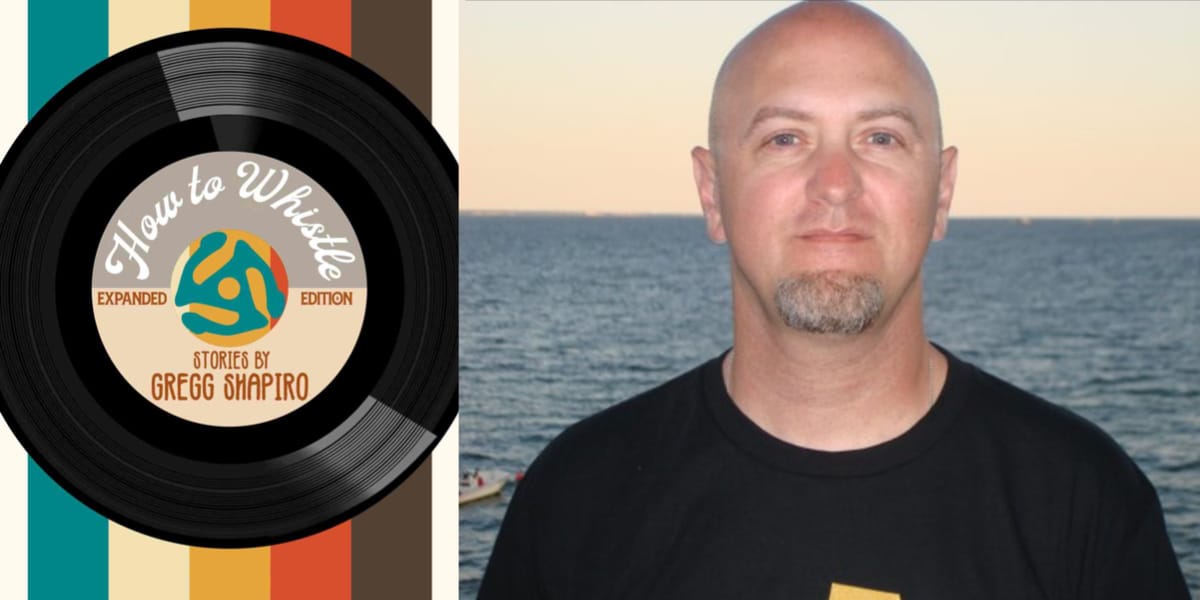
Gregg Shapiro, a 1999 inductee into the Chicago LGBT Hall of Fame, is the author of seven books including the expanded edition of his short story collection How to Whistle: Expanded Edition (Rattling Good Yarns Press, 2021). Recent lit-mag publications include Exquisite Pandemic, RFD, Gargoyle, Limp Wrist, Mollyhouse, Impossible Archetype and Dissonance Magazine, as well as the anthologies This Is What America Looks Like (Washington Writers’ Publishing House, 2021) and Sweeter Voices Still: An LGBTQ Anthology From Middle America (Belt Publishing, 2021). An entertainment journalist, whose interviews and reviews run in a variety of regional LGBTQ+ and mainstream publications and websites, Shapiro lives in Fort Lauderdale, Florida with his husband Rick and their dog Coco.