I’ve loved traveling for as long as I can remember, but rarely had the means to do it. My first trip to Europe overlapped the last week of my last quarter at U.C.L.A. My roommate, a Russian Studies student, invited me to join him on a two-month summer journey across Western Europe that would eventually thread through the then-called Soviet Union before we returned to Paris. Jacques and his family were French Communists living in the Simi Valley and, encouraged by his parents, Jacques wanted to see how people were getting on out there. His Russian was pretty good, he claimed, and he’d take care of the itinerary and visa applications. We’d share the expense of renting a car. How could I refuse?
So, during the week of my Summa Cum Laude graduation (when I would’ve received a gold braid from the Chancellor), we were already heading north from Paris to Belgium. From the city of Liege, we drove east through Germany on our way to Poland – a broad, flat country that, in those days, was still stamped with Soviet-style farms. The drive was long, the days hot, and finding suitable places to unroll our sleeping bags during the muggy nights became a challenge. So, my first writerly memory happened amid the haystacks of a remote Polish wheatfield under the fat yellow stars of July. They were soft, those haystacks, and our sleeping bags were thick enough to insulate us from the pricks of hay. But it was too hot to zip them closed, so we spread them out against the gentle slope of a big stack, stripped down, and stretched out – mosquitos be damned. I slept in my boxers, but Jacques, sticky from hours of driving, went native. Nothing happened. I knew what I felt but dared not do anything about it, and Jacques was straight – no doubt about it. All the same, the moment was magic. Because everything about the place – the stars, the smells, the sound of the wind, the man lying close to me – seemed so different, so alive with a sense of something strange and exciting ahead. What had shifted in me? To this day, I don’t know. But I remember that, shortly before dropping off, I’d decided that after this long adventure with Jacques, or even during it, I’d begin to write. I might’ve even said it aloud, first to myself and then to Jacques, who snored gently beside me. The comical end to this pastoral is that we were startled awake at the crack of dawn by a group of booted and pitchfork-wielding women who shrieked with laughter when they discovered two young men, one in the altogether, and the other almost so, sprawled on one of their haystacks. We rushed to dress, and they offered us bread and cheese. Soon, we were on the road again, headed straight for the Soviet border town of Lviv, now in the Ukraine.

Many adventures followed during our travels deeper into the Eastern Bloc, but the intention of this piece isn’t about traveling, but rather how traveling has inspired and informed my fiction-writing. In fact, fast forward some forty-five years, and this writer has put down roots far from the United States, in Umbria, Italy, where my creativity has taken on a new intensity, importance, and urgency for me that did not—could not—happen in my native country anymore. For nearly six months of the year, I sit at my desk before a window that looks over the Umbrian countryside of olive and persimmon trees. The window opens just above the moss-crusted tiles of my stone fienile, or barn, with its ancient cistern. The house and barn belonged to the nonna, now deceased, of a family close by, and the purchase was brokered by an artist friend who is now my neighbor. The house and barn were a package deal and affordable, so I could keep my house in California. Within a week of moving in, I knew I’d made the right choice. Something happens when you’re far from a place you’ve known all your life, a tabula rasa of imaginative possibilities replaces the default narratives. Familiar places and familiar people can cloud you with familiar associations and biases, making the stories you tell similar to the stories you’ve already told and the stories you write much like the stories others have written, especially now, as our country changes. Don’t get me wrong—there are thousands of stories that should be written about the United States, must be written about the United States by those who choose to call it home. But for me, it’s easier to write freely about my country when I’m far from it. The anger doesn’t interfere as much, nor does the despair. When I’m riled up by something I hear on the news, I look out the window at the 800-year-old hill town across a valley that’s turned golden from the flowering of broom. Then, I take a deep breath and write.
I don’t delude myself by thinking my situation is a kind of writer’s paradise. Italy is also changing, as people here are well aware. But there’s still a passeggiata in the late afternoon and a Campari before dinner. There’s often a neighbor on the doorstep offering olive oil, freshly pressed, and good bread. This takes the edge off—escapist comforts, to be sure, but living in Italy for half the year has also plunged me deep inside myself and shaken my understanding of who I am, all of which is good for making fiction. I grew up an Italian-American, and my early years were spent on the perimeters of New York City’s Italian-American emigrant neighborhoods. Note that even second- and third-generation Italians called them Italian-American neighborhoods, the “Italian” coming first, because cultural pride took precedence over the greater economic opportunities the New World offered. Cultural loyalty notwithstanding, emigrant Italians wished to succeed and discouraged their children from speaking Italian to avoid discrimination in 1950s New York. I heard much Italian at home and among relatives, but it was never taught to me. Of course, some of it stuck and—amazingly—still sticks today. But I will never master the language the way I might’ve when younger. So, there’s the first crisis as a long timer in a foreign country: you don’t know what’s going on. Your native friends will help you, the shopkeepers are kind and patient, the other expats you meet will recommend classes – but for the better part of a year, you’re standing on the banks of a great flowing river and can’t swim across to the promised land. As a writer who enjoys sharing words, this is alienating, but it had the unexpected advantage of driving me deeper into my own language and developing a new ear for it. I analyzed words and their impact in new ways. My writing became leaner and clearer, so turned off was I by the obfuscations of Italian grammar as I struggled to master it. This was most evident, at least to me, in my poetry. Surprisingly, this leaner poetry was also easier to translate into Italian, as my Italian friends told me.
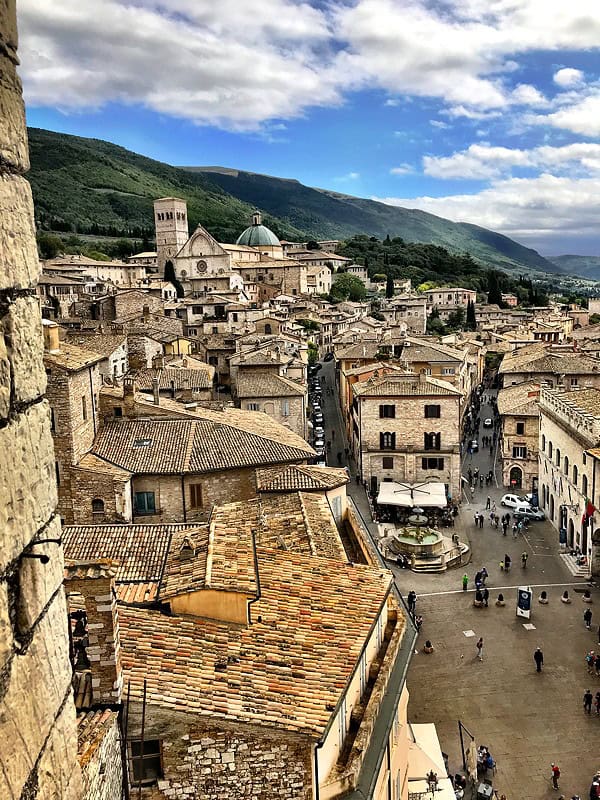
But here’s the real gist of it. Living in Italy as an expat has scrambled my sense of self, a scrambling that has led to some new ideas for stories because this disruption has forced me to re-examine what is (and isn’t) authentic about my cultural identity. Italian-Americans living in New York and other large eastern cities have a strange relationship to their ethnicity. They (we) believed we were authentic Italians, merely relocated and making do. We enjoyed, or so we thought, the same cuisine as native Italians, we celebrated holidays just as they still did, we used the same idioms and pejoratives, and we sustained a reverence, if more secular than religious, for the Pope. The darker side was that we also had a rigid sense of what was “right” and “wrong,” which sometimes expressed itself in a loathing—both passive and active—for same-gender attractions. But any Italian-American who visits today’s Italy and spends any length of time here quickly sees how off the mark this is. Social conservatism is more an American thing than an Italian one. I had my first same-sex experience in Italy at 24, and it was tender and guiltless and filled with joy. Since then, I haven’t yet met an Italian—north or south, east or west—who’s had a problem with two men traveling together, living together, and sleeping together. Although Italy has yet to take the final step in upgrading the current “domestic partnership” status to “marriage,” Italian domestic partners are entitled to be the full heirs to each other with all of the tax and healthcare advantages of married couples, including a continuation of the deceased partner’s pension for the surviving partner. It’s routine to see same-gender couples on Italian sitcoms, in Italian commercials, and one of the most popular TV shows today is Italy’s version of “America’s Got Talent,” featuring a judging panel of drag queens. Many LGBTQ persons work in public professions where they’re conspicuous and need not worry. It’s a very good thing to feel safe among people who also feel safe, because fear is the enemy of creativity. Because the strongest work comes from turmoil reflected upon in tranquility, as the poet Wordsworth said. For me, Italy is the perfect place for that to happen.

So here I am today, sitting in my office on a winter afternoon, watching light rain fall outside. A good day for writing with weather like this, and I have much to do. I’m less than a decade from changing decades and sense the preciousness of my remaining years. But I’m also one of the lucky ones. At twenty-three, I had an epiphany in a haystack—lightning-struck by an awareness of the exciting adventures that stretched before me. After the interruption of many years, I’ve continued that epiphany almost every day as I go about my daily life here. There is nothing quite like the pealing of a three-hundred-year-old church bell at noon, the magpies startled by it and abandoning their roosts. There’s nothing like driving along a country road and discovering a run of Roman aqueduct just ahead, your car directed to pass beneath it ever so daintily. And there’s nothing like drinking wine so good and so inexpensive that the local producers don’t even have a name for it other than the house whose vineyard it came from. These simple pleasures fire up the imagination, swell the heart, delight the senses, and remind me of how vivid and joyful life can be, even as age begins to draw down the shade. Taken together, these simple pleasures are my reason for living in Italy.
Writing the Lesbian Novel Infraction—without the Word Lesbian

My Writing Process

Success! (Eventually)