

Every time I visit a museum, no matter how keenly focused I am on what I’ve gone to see, I’m always ambushed by some unexpected discovery. This was the case a few years ago when I was touring the Davis Museum at Wellesley College in Wellesley, Massachusetts. I’d gone there to see their pre-Columbian collection, because I’m greatly interested in Mexican culture, ancient and modern. But that day, what totally enchanted me were not the Aztec ceramics, but an enigmatic painting by the Mexican artist Diego Rivera.
It was a portrait of the American poet, Mary Channing “Marina” Wister, which Rivera painted in 1931. In the painting, Rivera posed Wister, who was also an accomplished pianist, with her hands poised to play. Curiously, the piano is missing. Equally puzzling is the fact that she is decked out in horseback riding clothes, and a horse is rearing up behind her. The Italian phrase “Fantasia e Fuga,” which runs across a page of sheet music before her, references one of several compositions by Bach. Who, I wondered, was this Marina Wister who had inspired Rivera to make such a mysterious painting?
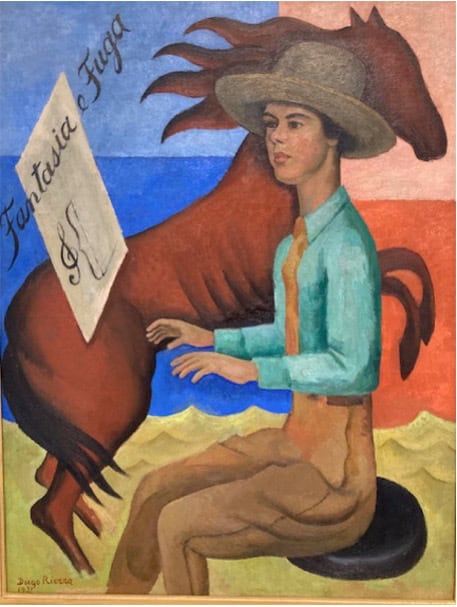
Wister was born in 1882, the daughter of Owen Wister, an American writer and historian, best remembered as the author of The Virginian, one of the first Western novels. In 1933, she married Andrew Michael Dasburg, an American modernist painter and an early champion of cubism, who had contributed to the famous 1913 Armory Show. Like his wife, Dasburg was attracted to Mexican culture.
Six years after Rivera painted her portrait, Wister published a book of poems, to which she gave the same title as the Rivera painting, Fantasy and Fugue. She dedicated her book: “Para mis amigos, D.R. and F.K. de R, como recuerdo,” a reference to her good friendship with Rivera and his wife, Frida Kahlo.
Wister’s book included 31 poems under the heading “From Mexico.” Each poem highlighted the landscape, the towns, and the people of this country that she deeply loved. On April 28, 1938, an anonymous reviewer in the New York Times noted that Wister’s Mexican pieces were particularly strong: “Miss Wister appears to have looked about her with keenly observing eyes,” adding that her poems were “vividly pictorial and colored.” I found a copy of the book and read Wister’s poems with delight and admiration. She was indeed an accomplished poet.
That winter, I took the poems with me to Mexico, where I’d gone to spend several months in order to escape Boston’s cold, dismal climate and to work on my new collection of short stories, Zigzag. I rented a small apartment in San Miguel de Allende. Located in the central Mexican plateau, San Miguel is a former Spanish colonial city, founded around 1541. It became enormously wealthy during the heyday of the Spanish silver mining enterprise. Today, the city is known for its mild climate; beautiful colonial architecture; vibrant art, music and crafts scene; great restaurants and cafés; and its warm and welcoming citizenry.
Once settled in, I soon discovered a weekly English-language newspaper, Atención, published for the thousands of tourists and expats who flood into the city every winter. The paper featured articles about the Mexican cultural scene. I pitched to the editor the idea of a short piece about Marina Wister and her Mexican poems. He went for it. That set me on a roll. Soon I was contributing a piece almost every week about another writer—either foreign or Mexican—who had written a novel, a play, poems, a travel book, a memoir, or short stories set in Mexico. My column was called “The Writer in Mexico.”
When Atención folded (a victim of the high cost of printing), “The Writer in Mexico” moved to San Miguel’s online journal, Lokkal, which bills itself as “a digital town square, of, by and for the community.” In the year and a half since, I’ve published close to 60 pieces in Lokkal.
I’ve written about several Mexican writers, including, of course, Octavio Paz and Carlos Fuentes, two of the Titans of twentieth-century Mexican literature. Many other Mexican writers I wrote about—Juan Rulfo, Mariano Azuela, Sor Juana de la Cruz, José Vasconcelos, Ilan Stavans, José Joaquín Fernádez de Lizardi, Fernanda Melchor, and Elena Poniatowska (yup, she’s Mexican)—were new to me. I loved reading their books and discovering the vast diversity of Mexican literature.
At least three of my pieces focused on Mexican authors who were gay—Luís Zapata, Carlos Monsiváis, and Salvador Novo. Novo outrageously so. He received the condemnation of none other that Diego Rivera (as macho a Mexican as they come), who called Novo one of a group of “pseudo-artists and bourgeois writers who, calling themselves poets, are in reality nothing more than pure faggots.”
In his “secret autobiography,” Pillar of Salt, Novo (1904-1974) described with candor and gusto his childhood and adolescence. The racy explicitness of his tales about “the formation of my adult libidinal predilections” led him to believe that he could not publish the book, which did not come out until years later. In 2014, the University of Texas Press brought out a superb English translation by Marguerite Feitlowitz, accompanied by 19 of Novo’s erotic sonnets.
More than half my “Writer in Mexico” articles have been about foreign writers who have written about Mexico. Most were American, but I’ve also done pieces on British, Russian, and Canadian writers. I’ve been astonished to learn how many non-Mexican writers were drawn to our southern neighbor: to its revolutionary bent, its landscape, its people, its complicated history with the United States, its “exoticism.” And here, too, several of these writers were gay.
Tennessee Williams spent time here in the 1940s, out of which came his wonderful play The Night of the Iguana. Michael Nava, known for his series of prize-winning crime novels featuring Henry Rios, an openly gay Mexican American criminal defense lawyer, also wrote a magnificent epic novel set in Mexico, City of Palaces. In it, one of the principal characters is homosexual.
I also wrote a piece on Sybille Bedford’s A Visit to Don Otavio: A Traveller’s Tale from Mexico, a terrific account of her trip through Mexico with her lover Esther Murphy. And another piece on Mexican American writer John Paul Brammer’s ¡Hola Papi!, a collection of sometimes humorous, sometimes poignant personal essays about the trials and triumphs of a “person with unique difficulty accessing heterosexuality.” Yet another article featured the trilogy of memoirs by the gay Mexican American writer and Pulitzer Prize nominee Richard Rodriguez.
People ask me if I’m inclined to write a novel set in Mexico. After all, I’d written one set in China. The temptation is there, but I feel that my five-winter stint in this beautiful, beguiling, maddening country is not yet enough time for me to presume to say something interesting or relevant about Mexico. Maybe, like Katherine Anne Porter, I’ll write some short stories set in this country I’ve come to love. But until that time comes, I’ll happily content myself with reading what others have written about Mexico and report on those books to my readers here. You can find my column at www.Lokkal.com in the “Magazine” section of the site.


Writing the Lesbian Novel Infraction—without the Word Lesbian

My Writing Process

Success! (Eventually)